
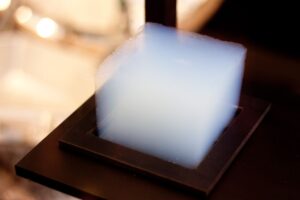
The Aerogel is a very light and solid substance
like a gel whose liquid component has been replaced by gas
The result is a translucent and transparent material, composed by 90-99.8% air and having many particular properties; the most important one is its thermal insulation, that made them famous because of their use in the space probes sent to Moon and Mars.
In fact, aerogel materials have a thermal conductivity of about 0,013-0,018 W/mK, making them the best thermal insulators on this planet. The formation of these materials, in general, involves two major steps, the formation of a wet gel, and the drying of the wet gel to form an Aerogel.
Steven Kistler of the College of the Pacific Stockton, California was the first who understood, in the 1931, the necessity to operate in supercritical conditions in order to avoid the collapse of the solid structure.
Aerogel materials can be produced as monoliths, thin-films, powders, or micro-spheres to respond to given application requirements.
The remarkable thermal insulation property depends on the almost abatement of three methods of heat transfer: convection, conduction, and radiation.
The most insulating Aerogel is the Silica Aerogel with Carbon added to it, which can insulate up to -200°C and which melts at 3000°C.
Aerogels are also the lightest solids in the world having typical densities of 3-150 mg/cm³; in the purest form it can even float on air.
(Source: Wikipedia and NASA)